

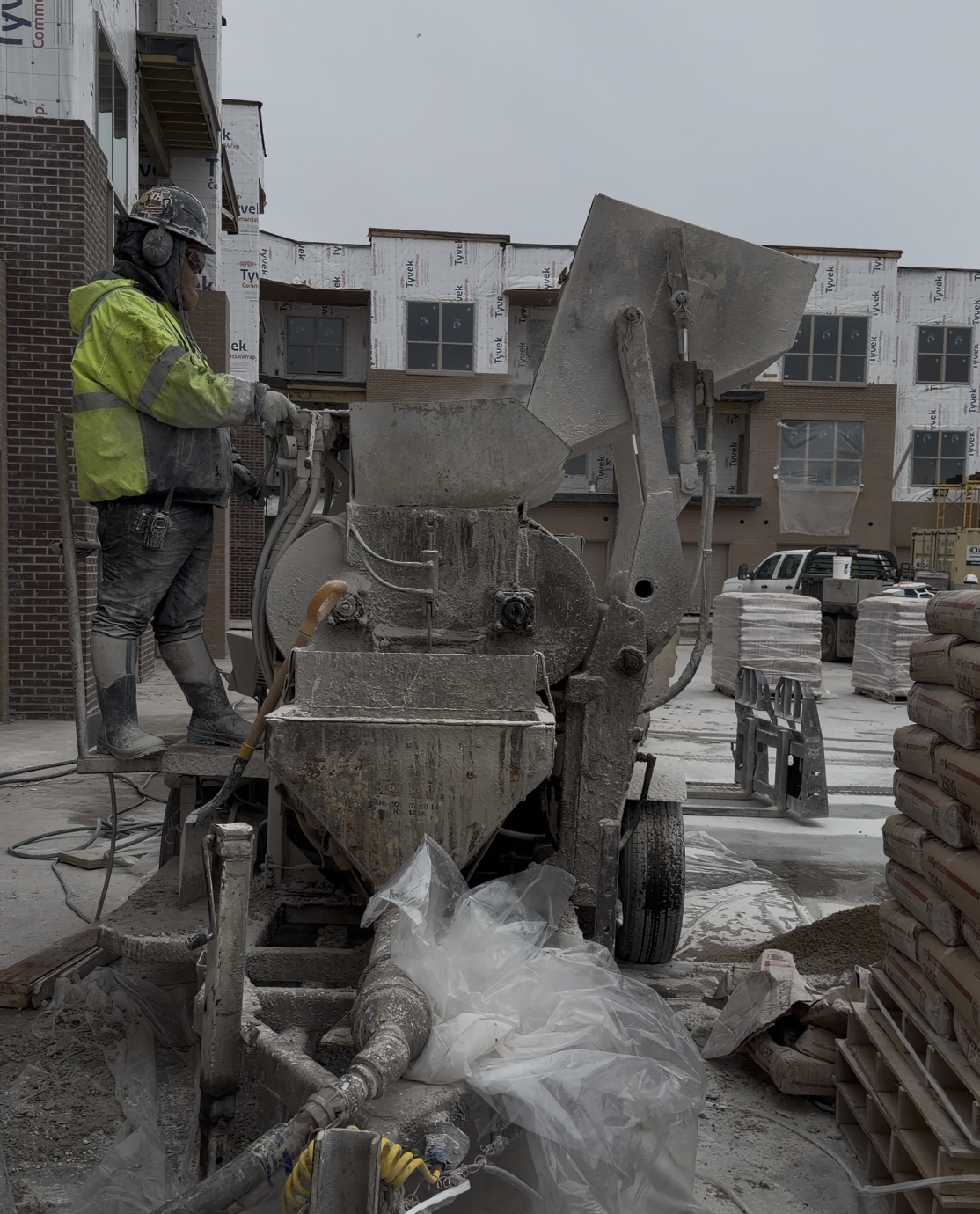
What is gypcrete flooring? If you’ve spent any time on multifamily or commercial builds, you’ve likely come across gypcrete flooring, but it doesn’t always get the attention it deserves during the spec process. This post breaks down what gypcrete flooring is, how it performs, and where it tends to make the most sense, whether you’re planning a new build or working through a renovation.
What is Gypcrete Flooring?
Gypcrete flooring, short for gypsum concrete, is a lightweight, poured underlayment applied beneath finish flooring. It’s mixed on-site and pumped into place over wood subfloors, concrete decks, or steel framing at a typical thickness of 1 to 1.5 inches. The result is a smooth, flat, and structurally consistent surface that’s ready for nearly any finish flooring system.
Compared to standard concrete, gypcrete is significantly lighter, roughly 13 to 18 pounds per square foot, which reduces dead load on wood-frame assemblies. It also cures quickly; foot traffic is generally possible within an hour or two of the pour.
How Gypcrete Flooring handles Fire ratings
Applied over a wood-framed floor assembly, gypcrete contributes to a 1- to 2-hour fire-rated system. Because the fire resistance is built into the floor assembly itself, it typically eliminates the need for separate fire treatments, which simplifies both the spec and the inspection process.
Sound control
A properly designed gypcrete assembly can achieve STC (Sound Transmission Class) ratings above 50, along with solid IIC (Impact Insulation Class) performance. That means meaningful reduction in both airborne noise and impact sound traveling between floors, an important consideration on any multifamily or mixed-occupancy project, and one that’s significantly more expensive to address after the fact.
Leveling Subfloors
Wood subfloors deflect, swell, and settle over time. Gypcrete’s self-leveling properties allow it to flow into low spots and bond to the substrate, creating a flat base that finish flooring can go down on cleanly. On projects with minor subfloor irregularities, this often reduces or eliminates the hand-floating work that would otherwise be needed before installation.
Gypcrete Flooring in New construction vs. Retrofit
Gypcrete flooring works well in both contexts, though the application looks a little different in each.
In new construction, it typically goes in early in the floor cycle. Crews can cover large areas quickly, and the fast cure time keeps other trades on schedule. On multifamily projects with floor-by-floor sequencing, the install speed is often a genuine schedule advantage.
In retrofit and renovation work, a gypcrete overlay can address leveling, acoustics, and fire assembly compliance in a single pour — without requiring a full demo of the existing floor. Substrate prep is the critical step; the existing surface needs to be clean, structurally sound, and properly primed before gypcrete goes down.
Radiant Heat Systems and Gypcrete Flooring
Gypcrete is a common choice when in-floor radiant heat is part of the design. It encases PEX tubing well, distributes heat evenly across the slab, and doesn’t require the additional thickness that standard concrete would. It’s a natural fit for healthcare, residential, and commercial applications where radiant systems are already in the mechanical plan.
Is Gypcrete the right call for your project?
The short answer is: it depends on the assembly, but it’s worth evaluating on almost any wood-frame or renovation job where fire rating, acoustics, or levelness are in play. The questions that matter most going in — floor type, finish flooring spec, fire and acoustic targets, and whether radiant heat is involved — are the same ones that shape how we approach scope and sequencing with our clients.
If you’re working through a spec and want a second set of eyes on whether gypcrete makes sense, the team at Kinzler Construction Services is happy to work through it with you. We handle gypcrete on both new construction and retrofit projects across Iowa and the Omaha metro — reach out and we’ll get you what you need.
